Internal B2B tool · Human-in-the-loop AI
Making allocation recommendations
clear enough to trust
I led UX research and interaction design for an internal logistics product that replaced fragmented SAP and spreadsheet workflows with recommendations planners could inspect, challenge and override.
Relevant for: Enterprise AI · Decision-support tools · Human-in-the-loop UX · Internal SaaS
- Role
- Lead UX Designer & Researcher
- Year
- 2022–2023
- Team
- Logistics · Data Science · Product
- Status
- Initial designs live in production
Context and role
01One decision, spread across SAP, Excel and experience
Global merchandisers balanced stock across thousands of stores and warehouses. The work moved between SAP, large spreadsheets and local rules held in people's heads. Comparing options was slow; exceptions were difficult to see; experienced planners carried much of the system's operational memory.
I mapped that workflow with merchandisers, logistics product managers, data scientists and software teams. My contribution covered research, workflow definition, interaction patterns, wireframes and the adaptation of H&M's Fabric system for a dense internal tool.
Company context: more than 150 global merchandisers were part of the operating environment. Reducing manual allocation work by 60% was an internal product target—not a measured design outcome.
150+
Merchandisers in the operating context
60% target
Internal goal for reducing manual allocation work
Live
Initial designs in the logistics supply chain
Central product problem
02A prediction was useless if planners could not question it
Allocation predictions already existed, but they arrived as opaque answers. Planners could not see why a market received a quantity, compare the signal with their own knowledge or record an intentional exception. The team did not need another dashboard. It needed a decision surface.
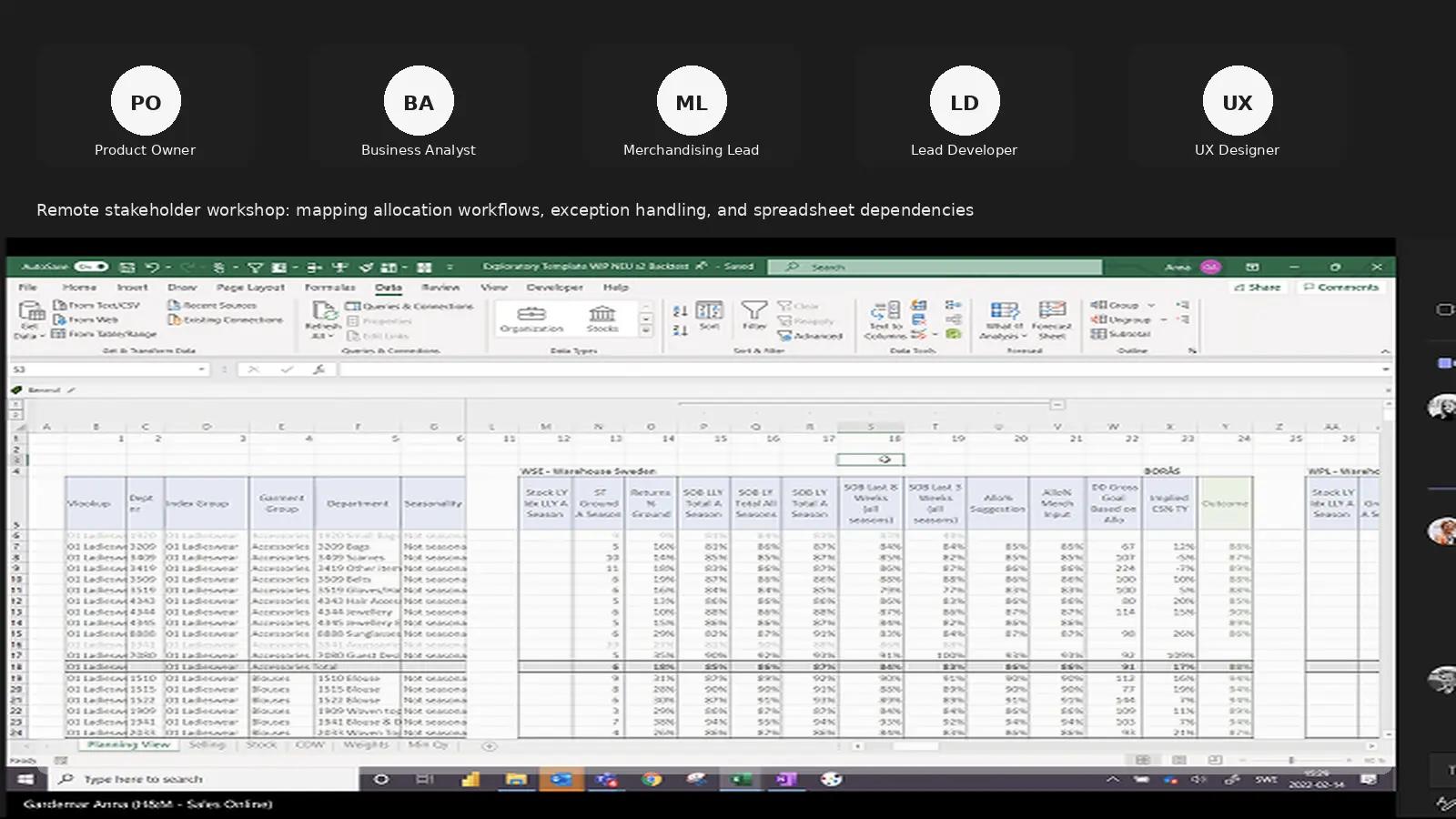
Anonymised workflow evidence: spreadsheets carried both data and local decision logic.
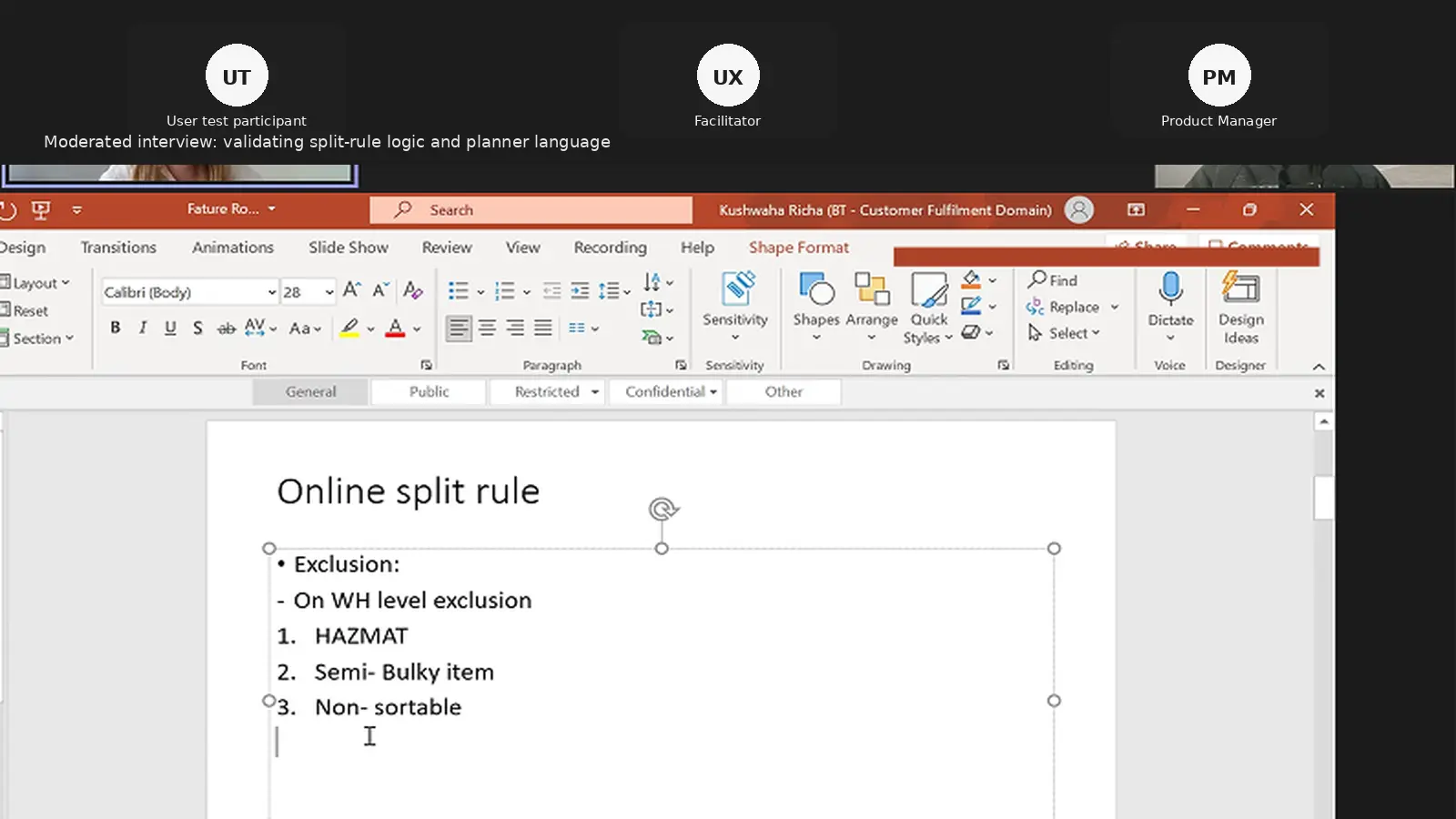
Interviews exposed the business rules and exceptions hidden behind a single allocation number.
Design principles
03Clarity, trust and agency
01
Clarity
Show the recommendation beside demand, historical variation and the exception that needs attention.
02
Trust
Expose confidence and model context so planners can inspect the basis of a suggestion before acting.
03
Agency
Keep override, simulation and approval explicit. The system proposes; the planner remains accountable.
Recommendation workflow
04Structure first, then the decision interface
The flow narrowed a large operational process into three actions: review the recommendation, inspect the signal and exception, then accept or override. Because production interfaces are confidential, the UI below is a portfolio-safe reconstruction based on the delivered workflow.
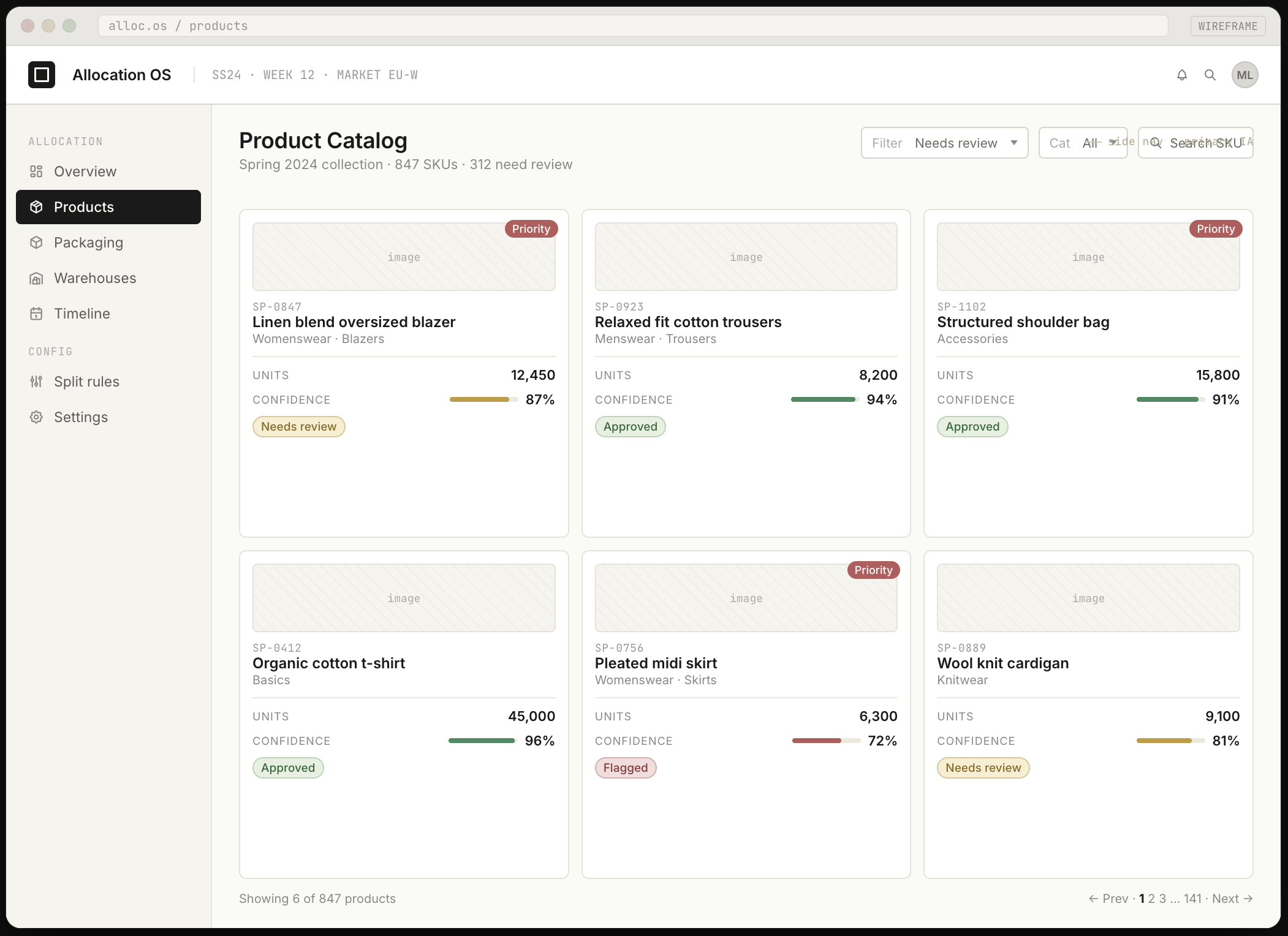
One structural wireframe: product triage, review state and confidence are visible before the planner opens a recommendation.
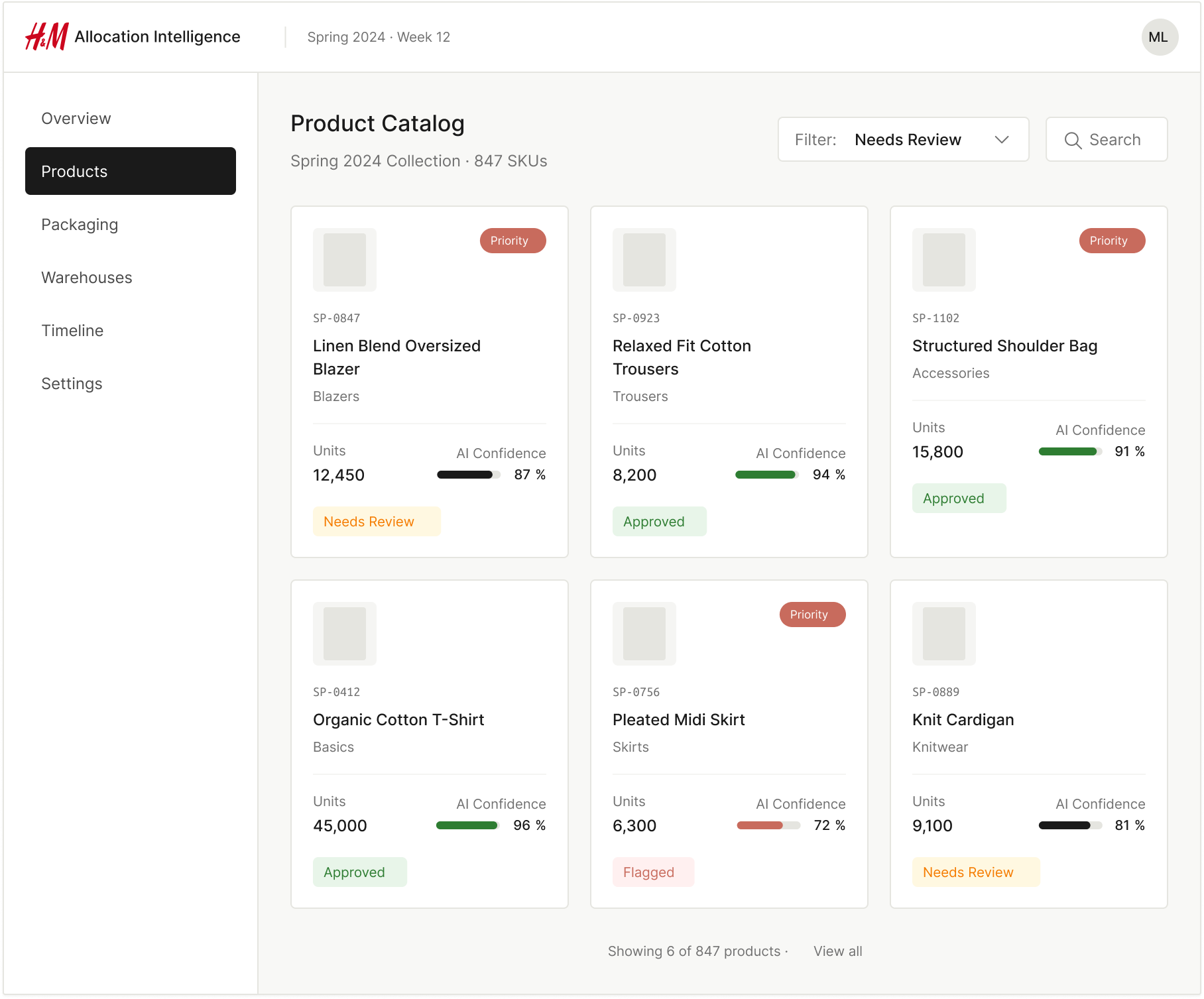
The corresponding catalogue view helps planners triage by status, allocation volume and confidence.
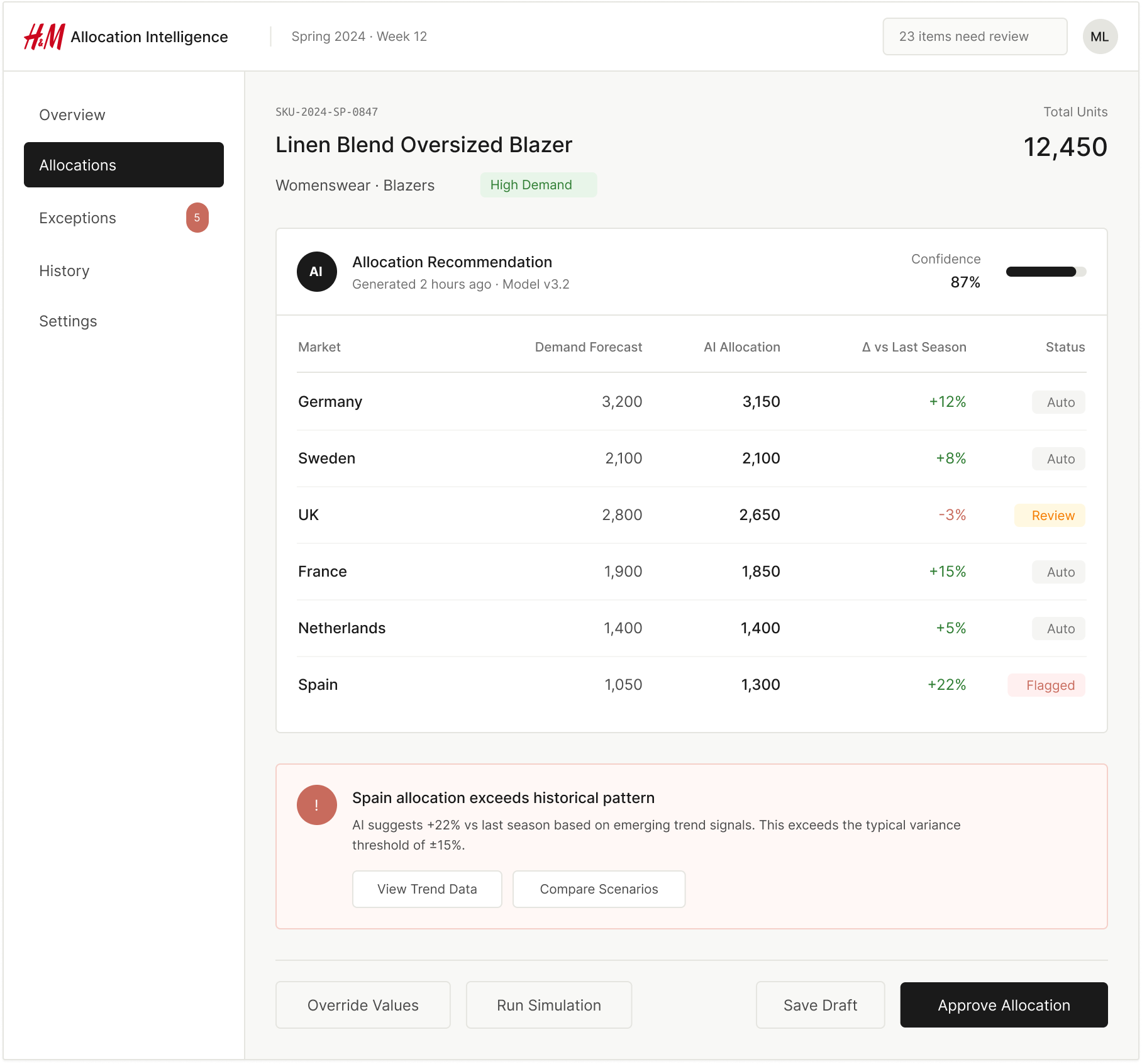
Recommendation, evidence, exception and human controls share one view. Planners can inspect a flagged market, compare scenarios, override values or approve the allocation.
Shipped result and reflection
05A system for judgement—not automatic approval
What shipped
Initial designs went live in H&M's logistics supply chain. The product brought recommendations, supporting signals and planner actions into one coherent workflow. The 60% reduction figure remained an internal target; this case does not claim it as a measured result.
What I contributed
I led interviews and workflow mapping, translated business rules into interaction logic, designed the recommendation and override patterns, and worked across logistics, product, data science and engineering to align the system around planner decisions.
Density
Compact rows made large SKU sets scannable without copying consumer spacing into an enterprise tool.
Confidence states
High, low, flagged and overridden states made machine uncertainty operationally visible.
Enterprise tables
Sorting, bulk review and inline exceptions became first-class patterns within Fabric.
Enterprise AI became a trust-design problem: make the machine legible, keep expert judgement active and give disagreement a safe path through the system.