Side Project · Founder-led
Simplifying Altruism Through Accessible Microdonations
Founder / Product Designer · 2023–Present
FINAL INTERFACE


Selected screens from the high-fidelity app design. Full interface below.
Overview · 02
Giving is hard.
It shouldn't be.
Donating effectively requires time, research, and emotional energy. Many users want to help but feel overwhelmed by choice, lack of transparency, and social discomfort.
Existing donation platforms often emphasise urgency, guilt, or large one-off donations — creating a stressful experience rather than a fulfilling one.
Solution pillars
Transparent Giving
Every euro mapped to real outcomes — mosquito nets, deworming kits, CO2 offset.
Personalised Giving
Cause categories and an AI guide connect users to what they genuinely care about.
Gamified Engagement
Impact milestones, shareable reports, and community visibility make giving rewarding.
SaaS for Charities
A partner dashboard gives NGOs tools to run campaigns and report impact transparently.
Research · 03
What people actually said
A Typeform survey and EA community interviews surfaced three consistent themes that shaped the product direction.
01
Transparency is non-negotiable
Users want to know exactly where their money goes and expect regular impact updates — not just a donation receipt.
02
Long-term causes, low monthly cost
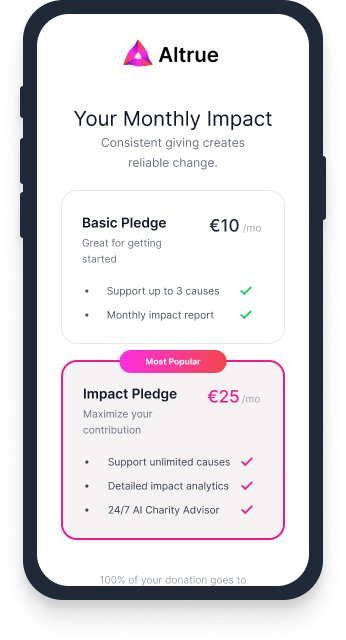
A strong preference for recurring contributions to ongoing causes over one-off emergency appeals. €10–€25/mo felt right.
03
Subscription feels familiar
Framing giving like Spotify or Netflix reduced anxiety and made the commitment feel manageable, not permanent.

Architecture · 04
Information Architecture
Four core pillars — Causes, Charities, Impact Reports, and User Profile — structure every navigation decision in the app.
Wireframes · 05
Mapping flows before pixels
Five key screens explored across onboarding, discovery, profile, and impact — validated with EA community testers before moving to high-fidelity.
Onboarding Flow
Landing Page
Profile Page
Discovery
Impact Page
Onboarding Flow
Landing Page
Profile Page
Discovery
Impact Page
AI IN MY WORKFLOW
AI as a prototyping layer, not a shortcut
Altrue started as a product and research concept. I used AI-assisted coding to move beyond static screens and test product logic more concretely — checking whether flows like onboarding, cause discovery, and impact reporting felt understandable as real interactions, not just polished Figma frames.
AI was useful for
Rough front-end implementation with Cursor and Claude Code
Component scaffolding and flow logic exploration
Figma Make for rapid visual direction testing
Test data structures for user testing sessions
Edge-case exploration across donation flows and cause matching
Product copy variations — finding the right tone for a trust-sensitive product
I kept human judgement for
Deciding which charities are trustworthy and why
How impact is framed and what claims are safe to make
Ethical boundaries around AI donation recommendations
What users should and should not be nudged toward
Visual quality and emotional tone of the experience
Tools
For a product built around donations and trust, the AI layer had to stay explainable, cautious, and clearly subordinate to user agency.
KEY FEATURE
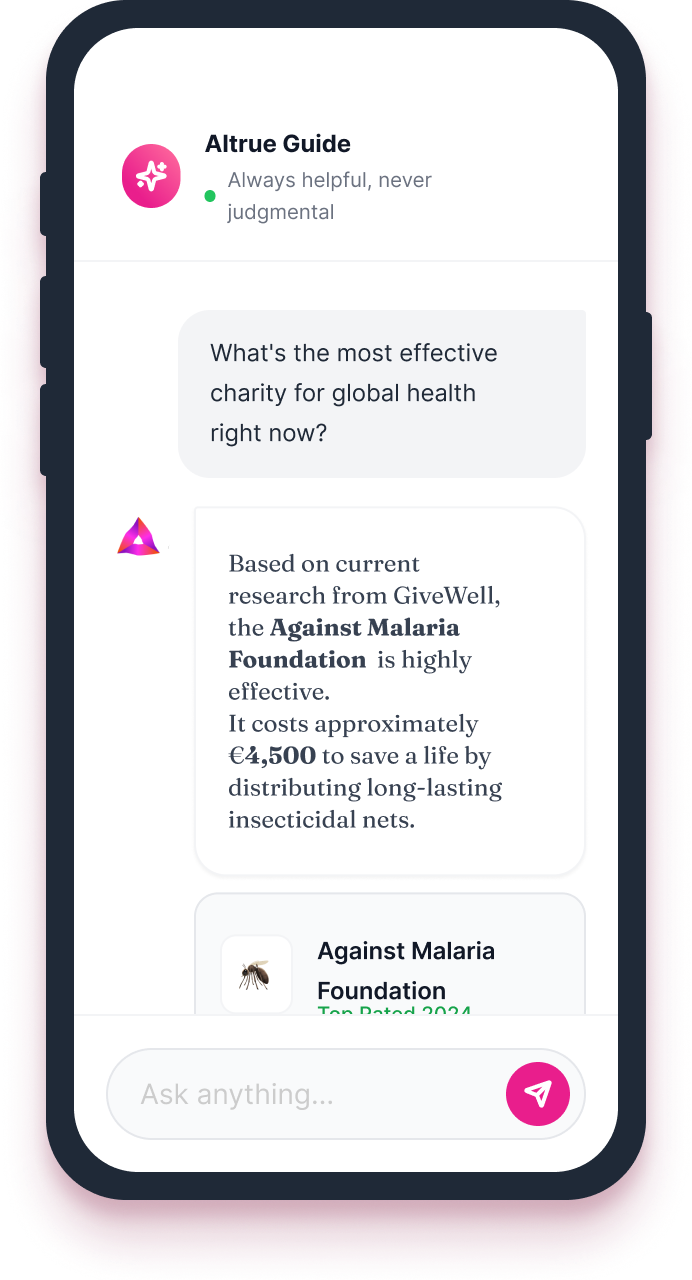
AI-Powered Guidance
Democratizing Effectiveness Research
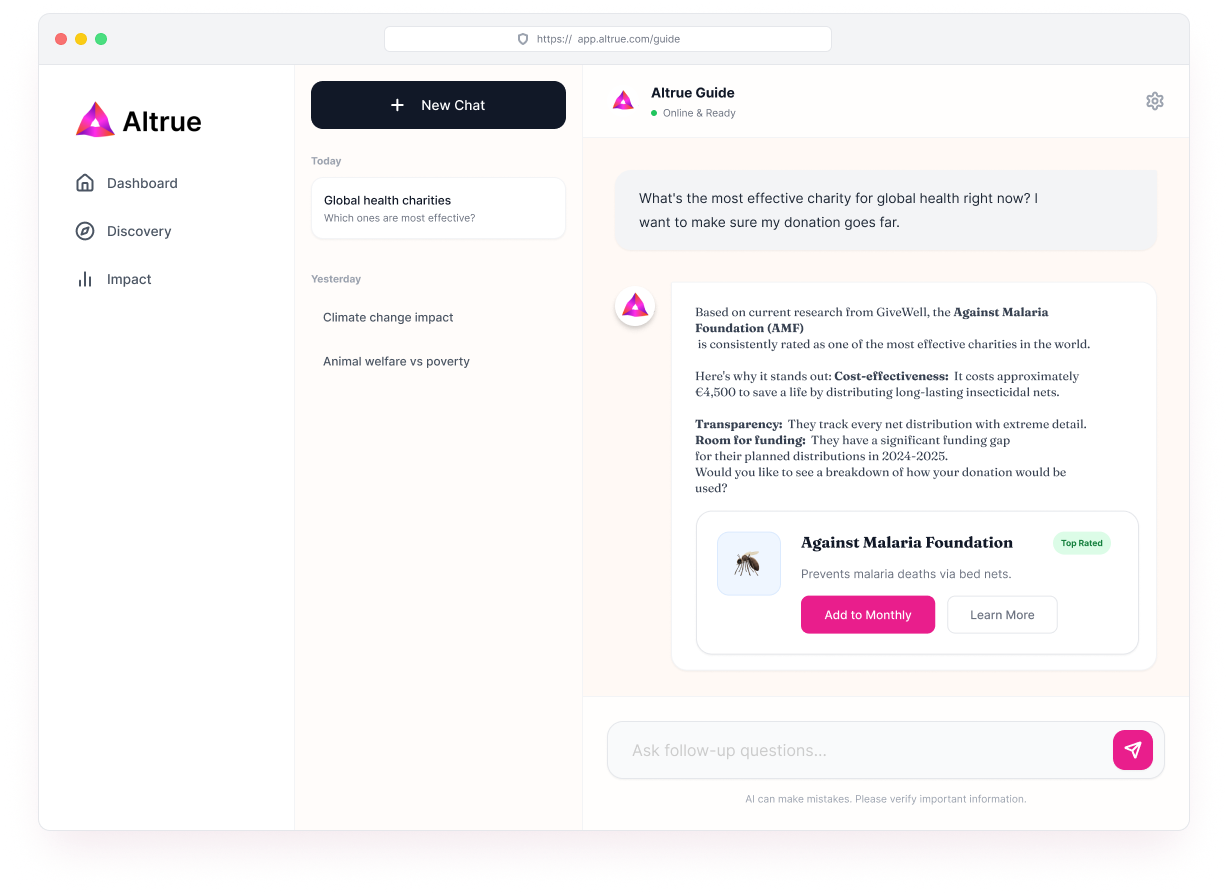
Effective Altruism research is often dense and academic. The Altrue AI Guide translates this complex data into simple, actionable insights. Different typography indicates the AI response vs the Human query and makes it easy to scan the interface while scrolling up or down.
Natural Language Queries
“Where can I help the most with $10?” instead of searching through spreadsheets.
Neutral & Non-Judgmental
Designed to encourage exploration without making the user feel guilty for not knowing.

Conversational Depth

Complex Topics
Explaining nuances like policy advocacy vs direct action in simple terms.

Personalized Advice
Creating custom giving portfolios based on user values and budget.
Also available on desktop

Full AI Guide experience on desktop, with chat history, contextual charity profiles, and one-click donation setup.
Interface Design · 06
A component-based system for warmth at scale
Built in Figma with a full component library using variables and variants — every token maps directly to the Flutter implementation for a seamless handoff.
Typography uses Fraunces — an expressive optical serif — for AI responses and display moments, paired with Inter for all user-facing UI. The split gives the AI voice warmth and intentionality without feeling machine-cold.
Gradients (magenta to deep purple) are applied at transition moments as an emotional cue — signalling momentum and possibility, not decoration.
AI voice · Fraunces (serif)
“Based on current research, the Against Malaria Foundation is highly effective...”
User voice · Inter (sans)
What's the most effective charity for global health?

Mobile onboarding concept introducing Altrue's core promise: giving that feels good, not guilty.

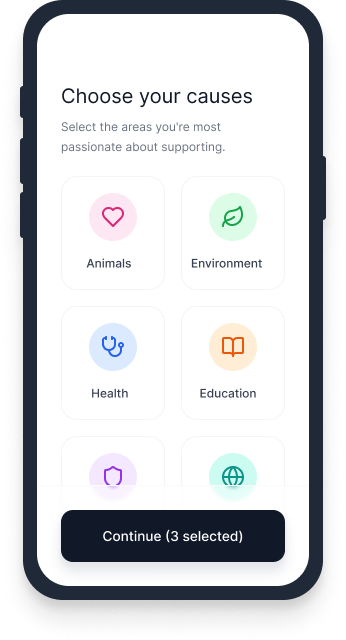
Cause selection flow helping users define the areas they care about most.

Monthly giving model showing subscription tiers and impact-led benefits.

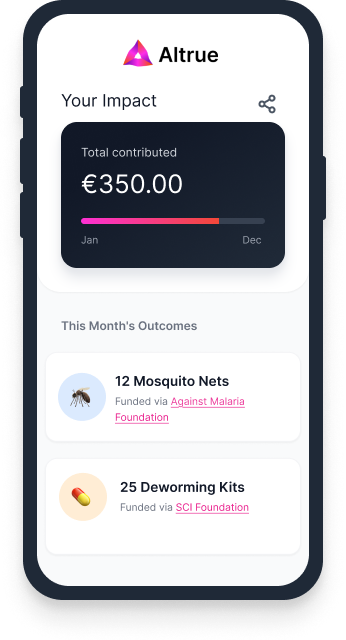
Mobile impact report showing outcomes funded through recurring giving.

Brand direction exploring typography, colour, gradients, and tone for a warmer AI-giving experience.

Component examples for actions, chat entry points, favourite states, and verified charity badges.
B2B · NGO Dashboard
SaaS Tool · 07
A platform for charities,
built by a designer
The partner-facing dashboard gives NGOs the tools to manage fundraising campaigns, track donor growth across demographics, and report impact transparently — turning Altrue into a B2B SaaS layer on top of the consumer app.

Partner-facing analytics dashboard for tracking donors, recurring revenue, and campaign performance.

Partner campaign management view for fundraising initiatives.
Analytics
Revenue, MRR, active donors, and avg. donation tracked in real time.
Campaigns
Create, manage, and pause fundraising campaigns with progress tracking.
Demographics
Donor age bands and geo breakdown to inform targeting and outreach.
Impact Potential · 08
Why this matters
Recurring donors give 42% more annually
Subscription-based giving fundamentally changes the donor relationship. Small, consistent contributions compound into meaningful impact — and create predictable funding streams for charities planning long-term programmes.
Trust is the biggest barrier to a first donation
Transparent impact reporting — showing exactly what each euro funded — directly addresses the fear that money disappears. Concrete outcomes ("12 mosquito nets this month") build lasting emotional investment.
Community multiplies engagement
When users share impact reports and see what their network supports, giving becomes social. Peer visibility drives new donor acquisition more effectively than any ad campaign.
Reflection · 09
Designing for altruism demands emotional sensitivity above all else.
The clearest lesson from this project: calm UX consistently outperforms persuasive UX in this context. When users feel safe and unpressured, they're far more likely to commit to long-term giving habits rather than making a single impulsive donation and disengaging.
Pitched at EA Global and EA conferences in 2023–2024. Feedback from the Effective Altruism community was encouraging — users highlighted the need for exactly this kind of beginner-friendly entry point into high-impact giving.
The curated choice architecture left people feeling relieved rather than overwhelmed, and clear impact metrics gave them a genuine sense of agency.
Positive feedback from
EffektivSpenden
Germany's leading effective giving platform
Giving What We Can
Global pledge community · 10% income pledge
GiveWell
Independent charity evaluator · Top Charities list
Current Status
MVP in Flutter — concept to working prototype. Actively developing with Cursor, Claude Code, Supabase, and the GlobalGiving API.